
Semaglutide vs tirzepatide: how to think about the choice
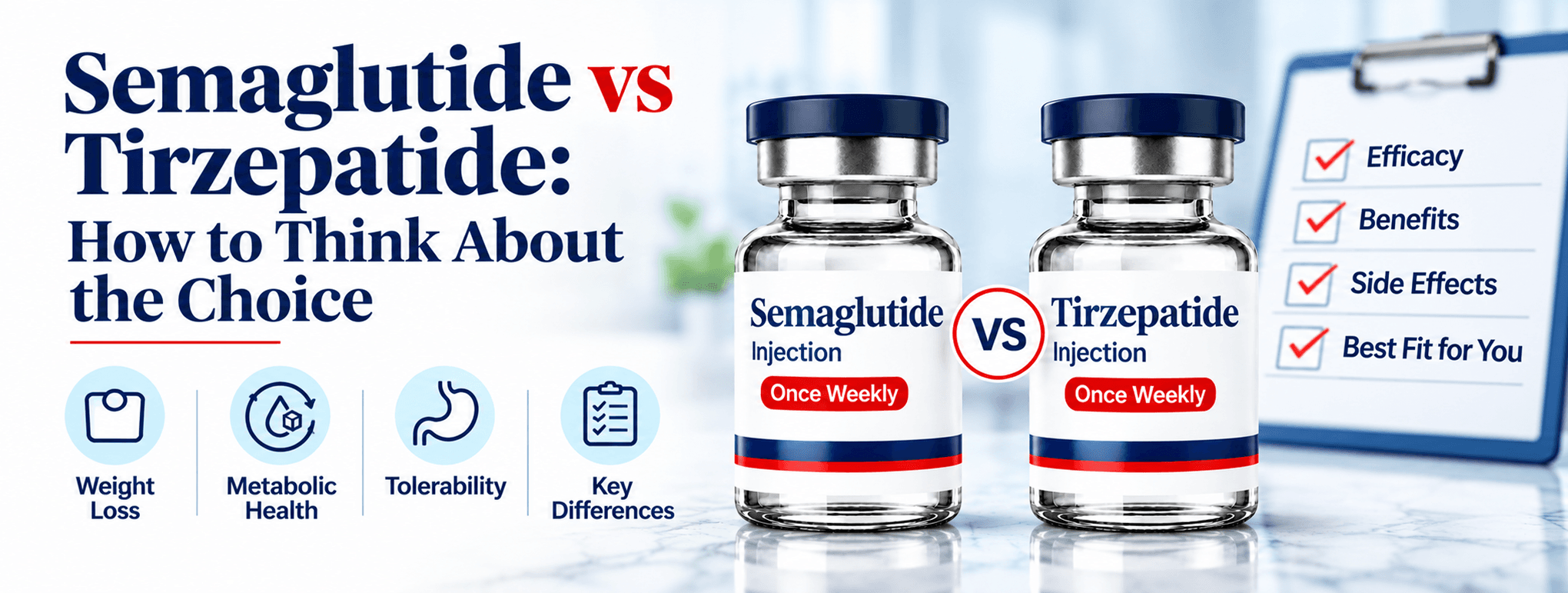
Semaglutide vs tirzepatide comes down to mechanism and fit. Semaglutide acts on the GLP-1 receptor; tirzepatide acts on both GIP and GLP-1 receptors. Neither is automatically better for a given person. Your prescriber weighs your history, tolerance, coverage and goals, and not everyone is eligible.
Semaglutide vs tirzepatide: what actually differs?
Start with the biology, because everything else follows from it.
Your gut releases hormones after you eat. Two of them, GLP-1 and GIP, are called incretins, and they influence insulin release, how fast the stomach empties, and how full you feel. Semaglutide mimics the action of GLP-1 at its receptor. Tirzepatide is a dual agonist: it acts at the GIP receptor as well as the GLP-1 receptor.
That's the entire mechanistic difference, and it's genuinely a difference rather than marketing. What it means for one specific person is much harder to say.
Semaglutide
• Receptor targets: GLP-1
• Manufacturer: Novo Nordisk
• Common brand names: Ozempic, Wegovy
• Administration: Weekly injection; a 25 mg oral tablet was approved on 22 December 2025.
• 503B batch compounding in 2026: Closed (shortage resolved on 21 February 2025).
Tirzepatide
• Receptor targets: GIP and GLP-1
• Manufacturer: Eli Lilly
• Common brand names: Mounjaro, Zepbound
• Administration: Weekly injection.
• 503B batch compounding in 2026: Closed (shortage resolved on 2 October 2024).
Why "which one is stronger" is the wrong opening question?
We're not going to hand you a percentage comparison, because a fair one would need a head-to-head trial we can cite, run in people like you, and reported the same way for both drugs. Cross-trial arithmetic - taking a number from one study and setting it beside a number from another with different participants, different durations and different endpoints - looks rigorous and isn't.
What matters more, in a clinic, is fit. Two people with the same starting weight can have completely different experiences on the same molecule. The one who tolerates the medication and stays on it for a year does better than the one who quits at week nine because the nausea was unmanageable, whatever the trial averages said.
There's a second reason to distrust the winner framing. Trials recruit people who meet strict criteria and then support them heavily, with regular contact, structured advice and a standing reason to keep showing up. That scaffolding does real work. Your own result depends on the molecule, and on whether the rest of your life can hold a plan up for a year.
The five things that actually decide it
What you've already tried. If you've been on one incretin medication and it didn't suit you, that history shapes the next decision more than any statistic does.
How you tolerate it. Gastrointestinal effects - nausea, vomiting, diarrhea, constipation - are the most commonly reported problems for both. Some people find one easier than the other, and there's no test that predicts which in advance.
Your other health conditions. Certain histories rule out one or both. That's what the intake questionnaire and your provider are for, and it's the part people skim.
Coverage and cost. Formularies don't care about pharmacology. Plenty of people end up on the molecule their plan will pay for, and that's not an unreasonable way to start. If you're paying cash, what each route costs has the arithmetic.
How your prescriber plans to titrate. Both are stepped up gradually under supervision. On a dose-priced program that step-up is also a price step-up, which is worth knowing before you start rather than in month four.
A third option that didn't exist two years ago
The choice used to be two injectables. It isn't anymore. Oral semaglutide 25 mg was approved on 22 December 2025 and launched in January 2026, and orforglipron, sold as Foundayo, was approved on 1 April 2026 as a once-daily tablet with no food or water timing restrictions.
If needles are the reason you never started, that changes your conversation completely. The oral options approved in 2026 covers what the trials reported.
What switching actually involves?
Switching isn't a swap. Your prescriber has to decide why the current medication isn't delivering - is it a plateau, a tolerance problem, an adherence problem, or something else entirely? - and each answer points somewhere different. Some plateaus resolve with time or with changes that have nothing to do with the drug.
You also can't run both at once. Combining two incretin medications isn't an approved approach, and it isn't something to improvise. Expect that conversation to take longer than you'd like. That's a good sign, not a stalling tactic.
Where compounded preparations sit?
FDA declared the tirzepatide shortage resolved on 2 October 2024 and the semaglutide shortage resolved on 21 February 2025, which shut the 503B batch-compounding route for both. 503A patient-specific compounding remains lawful where a prescriber documents an individualized clinical reason the commercially available product doesn't meet, such as a dose that isn't commercially available.
Compounded medications are not FDA-approved and are not reviewed by FDA for safety, effectiveness or quality.
How we approach it?
Our providers are licensed in all 50 states, the service is LegitScript-approved, and we work with 503A-compliant compounding partners. Our GLP-1 program is $149 a month at any dose, which takes the billing incentive out of the titration conversation entirely.
Whichever route you end up on, protecting muscle while you lose weight matters more than most people expect, and it's easier to build in from the start than to fix later.
Both are prescription-only, both follow a medical evaluation, and not everyone is eligible for either. Our program is for weight management. We don't treat type 2 diabetes. Wegovy, Ozempic, Zepbound and Mounjaro are trademarks of their respective owners and appear here descriptively.
Frequently asked questions
Is tirzepatide stronger? It acts on an additional receptor. Whether that translates into a better result for you specifically isn't something a website can answer.
Is Zepbound the same as Mounjaro? Both contain tirzepatide, marketed under different names for different approved uses. Check the current label for each.
Which has fewer side effects? Both share a similar gastrointestinal profile. Individual tolerance varies more than the drugs do.
Can I take both? No. Don't combine incretin medications.
Can I choose which one I get? You can state a preference. The prescription is still a clinical decision, and if a provider gives you whatever you ask for without asking why, that's a warning sign about the provider.