Is compounded semaglutide still legal in 2026?
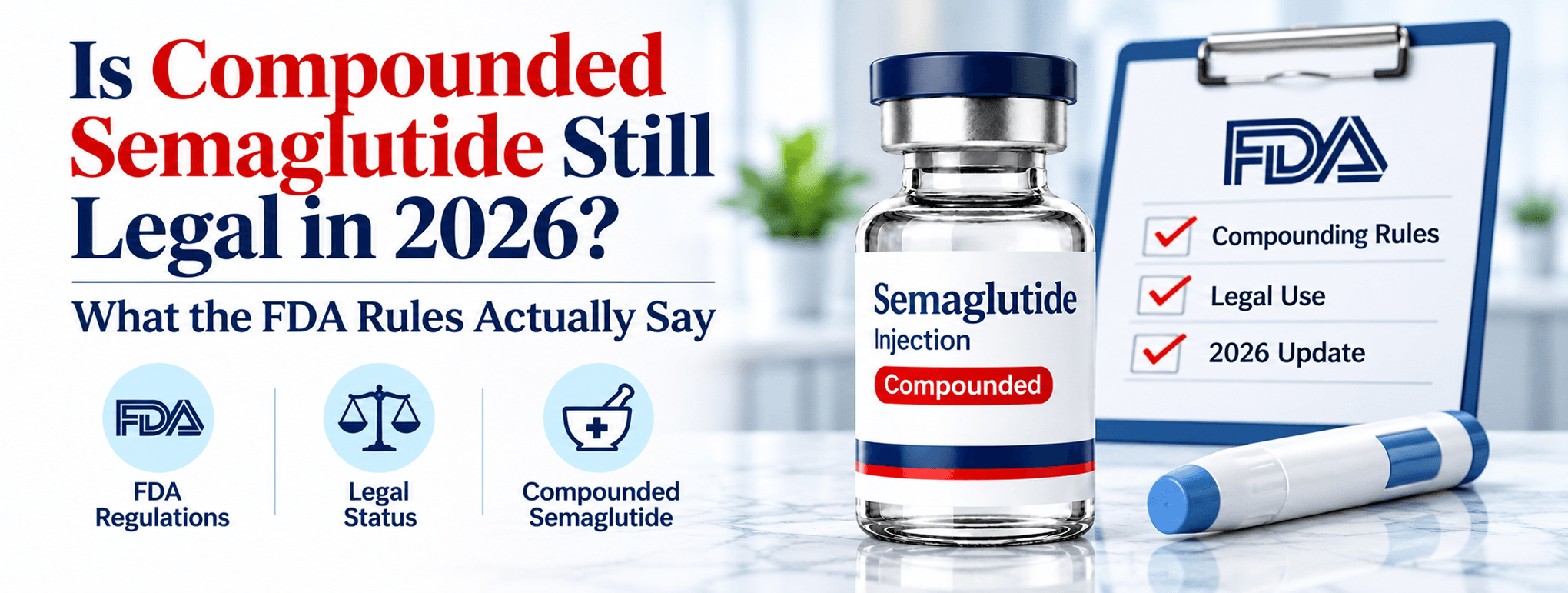
Yes, but only in narrow circumstances. FDA declared the semaglutide shortage resolved on 21 February 2025, which closed large-scale 503B batch compounding. A 503A pharmacy can still compound for one named patient when a prescriber documents a clinical reason the approved product doesn't meet.
Why this question keeps coming back?
You read a headline saying compounded semaglutide was banned. Two weeks later a package arrives from your clinic. Both of those things can be true at once, and the gap between them is where most of the confusion lives.
Nothing in 2024 or 2025 made compounding illegal. What changed is who is allowed to do it, for whom, and on what documented basis. That's a narrower door, not a locked one. Below is the version a pharmacist would give you if you asked over a counter.
What changed, and when?
Two dates carry most of the weight. FDA declared the tirzepatide shortage resolved on 2 October 2024. Semaglutide followed on 21 February 2025.
While a drug sits on FDA's shortage list, compounders have more room to work, because the point of that flexibility is to keep patients supplied when the approved product isn't there. Take the shortage away and the flexibility goes with it. That's the whole mechanism.
The clearest casualty was 503B. An outsourcing facility operating under section 503B of the Federal Food, Drug, and Cosmetic Act can make medication in batches, without a prescription naming a specific person, largely for clinics and hospitals. To do that from a bulk drug substance, the substance generally needs to be on FDA's 503B bulks list, or the drug needs to be in shortage. Semaglutide and tirzepatide are on neither. So that route is shut, and it isn't coming back on its own.
503A is a different license doing a different job
A 503A pharmacy is a traditional compounding pharmacy, licensed by its state board of pharmacy. It doesn't produce stock for the open market. It prepares a medication for one identified patient, against a prescription written for that patient by a licensed prescriber.
That pathway is still lawful in 2026. What it requires is a documented, individualized clinical reason the commercially available product doesn't work for that person. Two examples the field treats as legitimate: a dose that isn't available in any approved presentation, and a verified allergy or intolerance to an inactive ingredient in the approved product.
Here's the part clinics gloss over. Cost is not a clinical reason. Neither is convenience, nor preference, nor the pharmacy having stock on hand. If a provider tells you cheapness alone justifies compounding, they've just told you something useful about how they practice.
503A Pharmacy
• Made for: One named patient.
• Needs a patient-specific prescription: Yes.
• FDA-approved: No.
• Available for semaglutide in 2026: Yes, with documented individual clinical need.
503B Outsourcing Facility
• Made for: Batches, with no named patient.
• Needs a patient-specific prescription: No.
• FDA-approved: No.
• Available for semaglutide in 2026: No.
FDA-Approved Product
• Made for: The general market.
• Needs a patient-specific prescription: Yes, for prescription drugs.
• FDA-approved: Yes.
• Available for semaglutide in 2026: Yes.
What the 2026 warning letters were actually about?
In February 2026 the FDA issued warning letters to roughly 30 telehealth companies, and further action followed in June 2026. Read the pattern rather than the headline. The agency's concern was marketing: companies presenting compounded product as equivalent to the FDA-approved brands.
Sit with that for a second, because it's the most useful thing in this article. A clinic can be inside the lines on compounding law and still be in trouble for how it advertises. If a website tells you its compounded semaglutide is "the same as Wegovy", that isn't reassurance. It's a warning sign.
The sentence every patient should be able to repeat
Compounded drugs are not FDA-approved. FDA does not review them for safety, effectiveness or quality.
That isn't a technicality buried in a footer. A compounded preparation is made for you under state pharmacy oversight, on the professional responsibility of your prescriber and the pharmacy. It has not been through the review process that Wegovy, Ozempic, Zepbound and Mounjaro went through. Those are trademarks of their respective owners and are named here descriptively.
Five checks before you pay anyone
1. Ask which pharmacy dispenses your medication and in which state it's licensed. A clinic that won't name it has made your decision for you.
2. Ask whether a provider licensed in your state reviews your case. Not a questionnaire scored by software. A person.
3. Look for LegitScript certification. It's the standard most major ad platforms and payment processors rely on, and it's verifiable from outside.
4. Read the marketing, not the FAQ. Equivalence language to a branded drug is exactly what FDA wrote to 30 companies about.
5. Ask what the documented clinical reason is in your case. You're entitled to know why a compounded preparation was chosen over an approved one.
What your realistic options look like now
Three routes exist in 2026, and honest clinics will walk you through all three.
FDA-approved injectables, prescribed and dispensed as approved products. FDA-approved oral options, which are new: the 25 mg oral semaglutide tablet was approved on 22 December 2025 and launched in the US in January 2026, and orforglipron (brand name Foundayo) was approved on 1 April 2026 as a once-daily tablet with no food or water timing restrictions. And 503A compounded preparations, where a prescriber documents an individualized clinical need.
Which one suits you is a clinical decision, not a shopping decision. Your prescriber decides what, if anything, is appropriate for you, and some people won't be eligible for any of it.
Where The GLP Doctor stands?
We work with 503A-compliant compounding partners, our providers are licensed in all 50 states, and the service is LegitScript-approved. Our physician-supervised GLP-1 program is $149 a month at any dose, which removes the incentive to nudge anyone up a dose for billing reasons. If you want the arithmetic in full, read what a GLP-1 program really costs in 2026, and if tablets interest you, start with the new oral GLP-1 options. You can also read how the medical evaluation works before you commit to anything.
Compounded medications are not FDA-approved and are not reviewed by FDA for safety, effectiveness or quality. Treatment is prescription-only and follows a medical evaluation; not everyone is eligible.
Frequently asked questions
Did the FDA ban compounded semaglutide? No. It resolved the shortage, which removed the legal basis for 503B batch compounding. Patient-specific 503A compounding continues where an individualized clinical reason is documented.
Is compounded semaglutide FDA-approved? No. FDA does not review compounded medications for safety, effectiveness or quality.
Why is my clinic still shipping it? Most likely because a prescriber documented a clinical reason the approved product doesn't meet your needs. If nobody can tell you what that reason is, ask again, in writing.
Does the same apply to compounded tirzepatide? Broadly, yes. The tirzepatide shortage was resolved earlier, on 2 October 2024, and tirzepatide isn't on the 503B bulks list either.
Is a compounded version as effective as the branded drug? That comparison can't be made. Compounded preparations haven't been studied or approved as the branded products have, so nobody can tell you they perform the same.