Weight, testosterone and ED: why losing weight often fixes more than the scale?
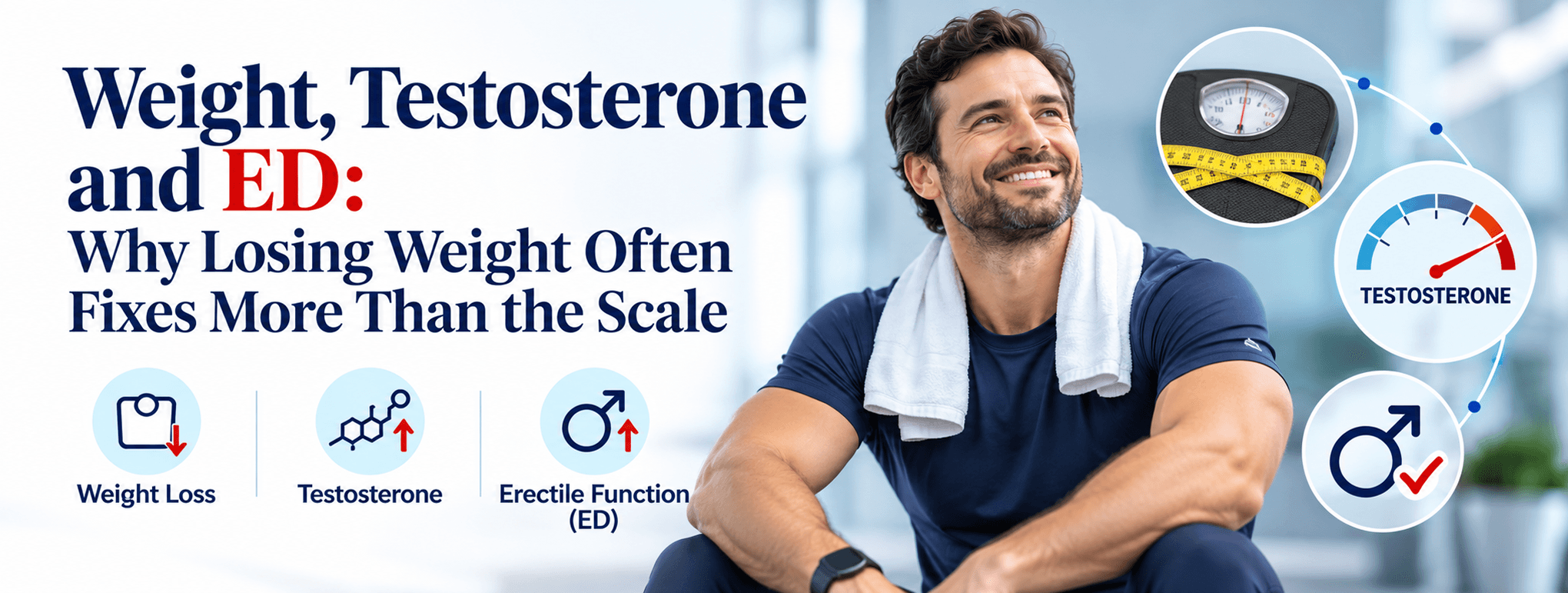
Often, yes. Excess body fat affects erections through three routes at once: blood vessel function, hormone balance and sleep quality. Losing weight can improve all three. It doesn't help everyone, and some causes of erectile dysfunction have nothing to do with weight, so get assessed.
Does weight loss help erectile dysfunction?
Most men asking this have already worked out the answer is probably yes and want to know how much, and how fast. The honest version is that it depends which of the three mechanisms is doing the damage in your case, and usually it's more than one.
Start with the part nobody explains properly. An erection is a blood-flow event. It depends on the lining of your blood vessels, the endothelium, releasing nitric oxide so the vessels relax and fill. Anything that damages that lining - high blood pressure, high blood sugar, smoking, the chronic low-grade inflammation that comes with excess visceral fat - makes the whole process less reliable.
The arteries involved are also small. Considerably smaller than the coronary arteries. That's the reason urologists take new ED in a man in his forties or fifties seriously as a cardiovascular signal rather than a nuisance. The plumbing narrows in the smallest pipes first.
What fat tissue does to testosterone?
Fat isn't inert storage. It's metabolically busy tissue, and one of the things it does is convert testosterone into estradiol using an enzyme called aromatase. More fat mass, more conversion. Visceral fat around the abdomen is the type most strongly tied to this.
Weight also drags on testosterone indirectly through insulin resistance and through sleep. So a man can end up with a genuinely low reading on a blood test, be told he has low testosterone, and be handed a diagnosis that treats the symptom rather than the driver.
This matters practically. Testosterone therapy is a real treatment with real indications, but it also suppresses your own production and can affect fertility. If the low reading is largely weight-driven, most clinicians want to see what happens when the weight and the sleep are addressed first. [CONFIRM: whether The GLP Doctor offers testosterone testing or therapy - the current product line is sildenafil and tadalafil, so the draft does not imply otherwise.]
The piece almost everyone misses: sleep apnea
If you snore, wake up unrefreshed, or your partner has mentioned you stop breathing, this section is the most useful part of the page.
Obstructive sleep apnea is common in men carrying extra weight, and it hits testosterone hard because most of your testosterone production happens during sleep. Fragment the sleep and you blunt the production. It also raises blood pressure and worsens vascular function, so it damages erections through two channels at once.
Then it feeds back. Poor sleep drives weight gain, weight gain worsens the apnea. Round it goes. Plenty of men chase a testosterone prescription for years while an undiagnosed apnea sits underneath the whole thing.
How the pieces connect?
1. Vascular
• What it does: Damages the vessel lining, so nitric oxide signaling and blood flow suffer.
• What tends to help: Weight loss, blood pressure and glucose control, stopping smoking, and exercise.
2. Hormonal
• What it does: Fat tissue converts testosterone to estradiol; insulin resistance lowers it further.
• What tends to help: Fat loss, particularly visceral fat; treating sleep apnea; clinical assessment before therapy.
3. Sleep
• What it does: Apnea fragments the sleep in which testosterone is produced and raises blood pressure.
• What tends to help: Sleep study, treatment of apnea, and weight loss.
4. Psychological
• What it does: Anxiety, low mood and relationship strain, often triggered by the first episode.
• What tends to help: Honest conversation with a clinician; sometimes therapy alongside medical treatment.
Where GLP-1 medication fits?
A GLP-1 doesn't treat erectile dysfunction. What it does is make substantial weight loss achievable for people who have struggled to get there, and weight loss is what moves the three mechanisms above.
The secondary effects are worth knowing about. As weight comes down, blood pressure and blood sugar often improve, sleep apnea severity frequently eases, and men commonly report that energy and libido pick up. Whether the erections follow depends on how much irreversible vascular damage is already there. Long-standing, poorly controlled disease doesn't undo itself.
Nobody can promise you that dropping 20 pounds fixes this. Some men see a clear difference. Some see none, and find the cause was something else entirely - a medication side effect, a nerve issue after surgery, a thyroid problem.
Where sildenafil and tadalafil come in?
The two most common prescription options work on the same pathway. They block an enzyme called PDE5, which lets the nitric-oxide signal your body already produces last longer. They don't create desire and they don't work without arousal.
The practical difference between them is duration. Sildenafil acts over a shorter window, so men tend to plan around it. Tadalafil stays active considerably longer, which some men prefer because it removes the scheduling. Which suits you, at what strength, is a prescriber's call - and there's a hard safety line here: these drugs cannot be combined with nitrate medication for chest pain, because the blood-pressure drop can be dangerous.
Treating the symptom while you work on the cause is a perfectly reasonable plan. It isn't cheating, and it often takes enough pressure off that the anxiety loop settles down.
What to do next?
Get the boring things checked: blood pressure, blood glucose, cholesterol, and a testosterone reading taken in the morning when levels are highest. Mention the snoring. List every medication you take, including anything for blood pressure or mood, because several affect erections.
Then treat what the results show. If weight is a driver, treating it addresses several problems at once instead of one at a time.
Frequently asked questions
How long before I notice a difference? There's no fixed timeline, and it varies with which mechanism was driving it. Vascular improvements are gradual. Sleep-related changes can be noticed sooner once apnea is treated.
Does belly fat really lower testosterone? Fat tissue converts testosterone to estradiol via aromatase, and visceral fat is also tied to insulin resistance and disrupted sleep. So yes, though the size of the effect varies between individuals.
Should I just ask for testosterone? Ask for the assessment first. Therapy suppresses your own production and has fertility implications, which is why clinicians want to know why the number is low before treating it.
Can I take sildenafil or tadalafil while on a GLP-1? That's a question for the provider who can see your full medication list. Don't combine prescriptions on the basis of a web page.
Is ED always physical? No. Anxiety and relationship stress are genuine causes, and they often coexist with a physical one. Both can be treated.