GLP-1 microdosing: what it is, who it suits, and what the evidence shows?
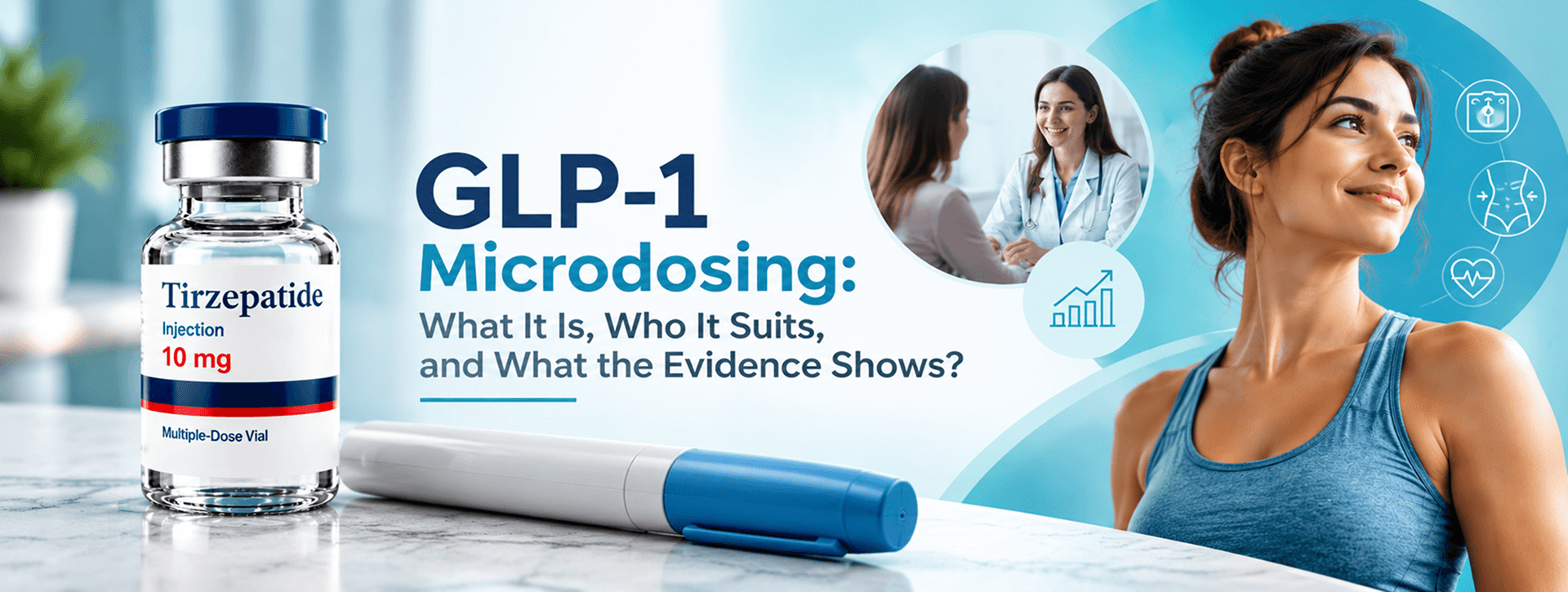
GLP-1 micro dosing means using a dose below the usual therapeutic range, often to limit side effects or hold a maintenance level. It is not an FDA-approved regimen, and the published evidence is thin. Any dose decision belongs to your prescriber after an individual evaluation.
What GLP-1 micro dosing actually means?
The word arrived from somewhere else entirely, which is part of the problem. In GLP-1 conversations it's used loosely for at least three different things: staying at a starting dose instead of stepping up, using an amount below the lowest studied dose, or stretching a supply by spacing doses further apart.
Those are not the same practice and they don't carry the same risks. The third one, in particular, is usually a budgeting decision wearing a clinical costume.
This page deliberately contains no numbers, because a dose is a prescription and a prescription is written for one person. What we can do is set out where the idea came from, what's actually known, and which version of it a good clinician might reasonably support.
Why the idea took hold?
Three real problems drove it, and none of them are silly.
Side effects are the first. Nausea, vomiting and constipation are the most commonly reported issues on these medications, and for some people they're bad enough to end treatment. If a smaller amount kept some of the benefit with less of the misery, that would matter enormously.
Cost is the second. On most programs the price is tied to the dose, so the bill climbs as you titrate. Stretching a supply looks like a way out of that. It isn't, and we'll come back to why.
Maintenance is the third, and it's the most interesting. People who've reached their goal want to know whether they need the full dose to stay there. That's a legitimate clinical question, and it's being asked far faster than the research can answer it.
What the evidence actually shows?
Here's the honest answer: we don't know yet.
The trials that produced the numbers you've read about studied the dose ranges in the approved labels. Sub-therapeutic dosing wasn't the question they were designed to answer, so they can't answer it. That's not a criticism of the trials - it's just what they were built to do.
So when someone online tells you micro dosing gives you most of the result with none of the side effects, ask where that comes from. Usually it's a personal account. Personal accounts are real, and they're also unblinded, uncontrolled, and told by people who felt like posting.
In terms of common claim and where the evidence stands we can see the data below
Common claim
Fewer side effects at lower doses: In terms of where the evidence stands it is Plausible on general dose-response grounds, but not established for a specific micro dosing regimen.
Similar weight results for less money: Not supported. No trial has compared sub-therapeutic dosing to labeled dosing on weight outcomes
Better for long-term maintenance: An open question. Being actively discussed clinically; the data isn't there yet
Protects lean mass better: No evidence for this specifically. Protein intake and resistance training are the better-supported levers
Nobody can tell you a smaller dose will give you a similar result, because that comparison hasn't been run.
Where a lower dose is a legitimate clinical decision?
This is the part that gets lost in the noise. Prescribers adjust doses all the time. Holding someone at a lower dose because they're responding well, or because they can't tolerate a step up, is ordinary medicine, not a hack.
A prescriber can also direct a 503A pharmacy to compound a preparation for one identified patient where they document an individualized clinical reason the commercially available product doesn't meet - a dose that isn't commercially available, for example. That pathway remains lawful in 2026, after the FDA declared the semaglutide shortage resolved on 21 February 2025 and the tirzepatide shortage on 2 October 2024. What it isn't is a way around a price. Cost has never been a lawful compounding justification. What 503A compounding does and doesn't allow has the detail.
Compounded medications are not FDA-approved and are not reviewed by FDA for safety, effectiveness or quality.
The risks nobody posts about
Self-adjusting is where people get hurt. Splitting a device that wasn't designed to be split, stretching intervals to make a supply last, or transferring medication between containers all introduce dosing errors, and some introduce contamination risk. None of it is visible until something goes wrong.
There's a slower risk too. A dose too low to do much can keep you on a medication, and a monthly bill, for months without progress — and it can delay the conversation about whether something else would suit you better. That's a quiet way to waste a year.
How flat pricing changes the arithmetic?
A lot of micro dosing talk is really cost talk. If your program charges more as your dose rises, every titration step is a bill increase, and staying low starts to look financially attractive whether or not it's clinically right.
We price the other way round. $149 a month at any dose means the number doesn't move when your dose does, so there's no financial reason to stay low and none to go high. Your prescriber makes the clinical call and the billing stays out of it. [CONFIRM: whether The GLP Doctor's providers will consider lower-dose maintenance plans, and how that should be described] If you want the full comparison, what a GLP-1 program really costs lays out twelve months of both models.
Our providers are licensed in all 50 states, the service is LegitScript-approved, and we work with 503A-compliant compounding partners. Treatment is prescription-only and follows a medical evaluation; not everyone is eligible. Ozempic, Wegovy, Zepbound and Mounjaro are trademarks of their respective owners and are named descriptively.
What to ask your prescriber?
Bring the specific thing you're trying to solve. "The nausea is unmanageable on Thursday and Friday" gets you somewhere. "I read about micro dosing" doesn't. Ask what a lower dose would mean for your plan, how they'd monitor it, and what would trigger a change. And if you're worried about muscle rather than the scale, protecting muscle on a GLP-1 is the more useful conversation to have.
Frequently asked questions
Is microdosing the same as slow titration? No. Slow titration is a supervised route to a target dose. Microdosing usually means staying below the studied range indefinitely.
Is it safe? Safety outside the studied range hasn't been established. That's not the same as saying it's dangerous, and it isn't the same as saying it's fine.
Will it save me money? On a dose-tiered program, yes, and that's exactly why the practice spread. On a flat-priced program the question disappears.
Can I split my own doses? Don't. Talk to your prescriber instead.
Will more research come? Very likely. The question is too commercially and clinically interesting to stay unstudied. Check back.